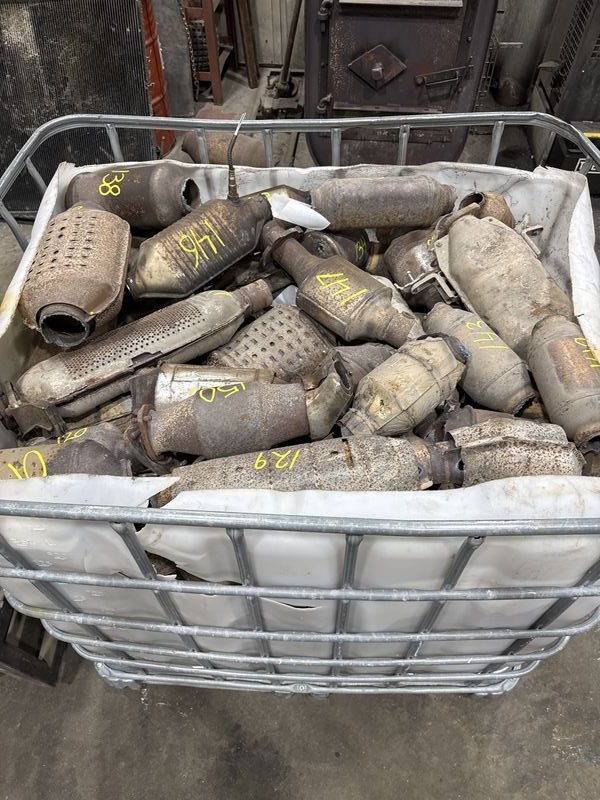
What Actually Happens to a Catalytic Converter After You Sell It?
Most people know catalytic converters are worth money. Fewer people know why — and that gap costs sellers real dollars every time. If you're sitting on a pile of cats and wondering why one buyer quotes you $40 and another quotes $180 for the same part, the answer lives inside the converter itself. Understanding how catalytic converter recycling works is the fastest way to stop leaving money on the table.
This is especially relevant in Fort Wayne, Indiana, where a mix of auto salvage yards, independent recyclers, and national buyers all compete for the same inventory. Knowing the process gives you leverage in every conversation.
Inside the Converter: Why Platinum Group Metals Drive Everything
A catalytic converter does one job: it converts toxic exhaust emissions into less harmful gases. The chemistry that makes this possible relies on three metals — platinum, palladium, and rhodium — collectively called platinum group metals (PGMs). These metals are embedded in a ceramic or metallic substrate (the honeycomb-looking core inside the shell).
PGMs are genuinely rare. Global annual production of rhodium, for example, runs in the single-digit tons. That scarcity is why catalytic converter prices track global commodity markets — not just local scrap metal demand. When palladium prices spike on the London Metal Exchange, your converter becomes worth more overnight. When they drop, so does your quote.
Here's what's inside a typical catalytic converter:
- Outer shell: Stainless steel — recyclable, but worth very little on its own
- Substrate (core): Ceramic (most common) or metallic — this is where the PGMs live
- Washcoat: Aluminum oxide layer that holds the PGMs in place
- PGM loading: Platinum, palladium, and rhodium — the actual value
The exact quantity of each PGM varies dramatically by vehicle make, model, engine size, and model year. A converter from a late-model V8 truck can carry significantly more PGM loading than one from a compact economy car. That's why serial tracking and VIN lookup tools — features built into platforms like get competitive bids for your scrap metal — matter. They connect specific converters to known PGM data, giving buyers confidence and giving sellers a defensible price.
The Recycling Process Step by Step
Once a catalytic converter leaves your yard or garage, it moves through a well-established refining chain. Understanding each stage explains why the timeline from "sold" to "processed" can stretch days or weeks — and why documentation matters throughout.
- Collection and sorting: Converters are sorted by type (OEM, aftermarket, foreign, domestic) and condition. Aftermarket "biscuit" converters typically carry less PGM loading than OEM units, so they sort separately from the start.
- Decanning: The outer steel shell is cut away, leaving just the substrate core. The steel gets recycled separately as standard scrap.
- Sampling and assay: Cores are crushed or milled into a homogeneous powder. A sample is pulled and sent to an assay lab. This is the step that reveals the actual PGM content — not an estimate, but a measured result.
- Smelting: The powdered material is processed at high temperatures to separate and concentrate the PGMs. This typically happens at a toll refinery or large smelter, not at a local scrap yard.
- Refining: The concentrated PGMs are separated into pure platinum, palladium, and rhodium using chemical and electrolytic processes.
- Settlement: The refiner reports the results to the buyer. Payment flows back through the chain — refiner to buyer, buyer to the original seller.
That chain is long. It's also why reputable buyers in Fort Wayne and across Indiana rely on documentation — photo documentation, serial numbers, and packing lists — to protect everyone involved. If you can't verify what you shipped, you can't dispute a settlement you believe is wrong.
Why Catalytic Converter Prices Vary So Wildly
This is the question that trips up sellers more than any other. You get three quotes for the same load of cats and they're nowhere near each other. Here's what's actually driving that spread.
PGM spot prices move daily. Platinum, palladium, and rhodium trade on global commodity markets. A quote you received last Tuesday may be meaningfully different from a quote today — not because anyone is being dishonest, but because the underlying metal prices shifted. For sellers chasing the best scrap metal prices Fort Wayne buyers can offer, timing matters.
Converter type and condition vary significantly. A foiled-out converter (one where the substrate has deteriorated or been tampered with) is worth a fraction of an intact unit. Buyers build this risk into their offers. If your inventory is well-documented and clearly intact, you should see stronger bids.
Buyer margin and business model differ. A local scrap yard near me auto parts buyer is likely holding inventory before shipping to a processor. They build a margin into their offer to cover that risk and cost. A buyer working through a competitive auction platform faces market pressure to bid closer to true value. More competition means better price discovery — that's not opinion, it's how auctions work.
Volume and relationship history matter. Established accounts with consistent volume often see better pricing. This is where scrap metal inventory management pays off — if you can show a buyer a clean, documented history of what you move, you're a lower-risk supplier, and lower-risk suppliers get better terms.
How Fort Wayne Sellers Can Get a Stronger Price on Cats
Fort Wayne has a legitimate scrap ecosystem — auto salvage operations, recycling facilities, and buyers who source from across northeastern Indiana. That gives sellers options. Options only help you if you use them.
Here's what experienced sellers do differently:
- Sort before you sell. Don't mix high-value OEM converters with low-value aftermarket units in the same lot. Blended loads get priced at the lower end. Sort by type and let buyers bid on each category separately.
- Document everything. Photo documentation before a load ships protects you if there's a dispute at settlement. It also builds the kind of supplier credibility that earns better long-term pricing.
- Use serial tracking when possible. Many converters have identifiable serial numbers that connect to published PGM data. If you can tell a buyer exactly what they're bidding on, they can bid with more confidence — and confidence translates to higher offers.
- Get multiple bids. This sounds obvious, but most sellers default to their single existing buyer out of habit. A B2B scrap metal marketplace that puts your inventory in front of multiple vetted buyers in a competitive format can surface price differences that a single-buyer relationship never will.
- Track commodity prices. You don't need to become a metals trader. But knowing whether palladium is trending up or down before you decide to sell a load can be meaningful. Holding a load for two weeks isn't always the wrong call.
Platforms like SMASH are built for exactly this — bringing documented inventory to a vetted pool of competitive buyers, without requiring a subscription or upfront fees. If you want to sell your scrap metal on GetMyScrap, the process starts with getting your inventory documented and in front of more than one buyer.
What Documentation You Need Before You Sell
Recycling yards and buyers in Indiana and across the country are increasingly requiring documentation before they'll accept catalytic converter loads. This isn't just bureaucracy — it's a response to theft-driven supply chain problems that pushed state-level regulations forward over the past several years. If you're selling in volume, documentation is non-negotiable.
At minimum, have the following ready before any load ships:
- Photos of each converter, including any visible serial numbers
- A packing list with quantity, type (OEM, aftermarket, small, medium, large), and condition notes
- Proof of business or supplier identification (for B2B transactions)
- Bill of lading (BOL) for any freight shipment
For high-value loads, some buyers will also request VIN documentation if converters came from whole vehicle purchases. The more documentation you can provide, the fewer questions arise at settlement. And no questions at settlement means faster payment. You can get a fair price for your scrap today when buyers can verify exactly what they're purchasing — documentation makes that possible.
If you're new to selling cats in volume and want to understand the full landscape before committing to a buyer, explore scrap metal selling guides covering everything from pricing basics to documentation best practices.
The Bottom Line on Catalytic Converter Recycling
Catalytic converter recycling isn't complicated once you understand what drives value. PGM content is everything. The type of converter, its condition, the current commodity market, and how many buyers are competing for your load — all of that shapes the final number. Sellers who treat cats like generic scrap metal consistently underperform. Sellers who document, sort, and create competition around their inventory consistently do better.
Fort Wayne is a real market with real buyers. If you're hunting for the best scrap metal prices Fort Wayne offers on catalytic converters, the answer isn't finding a better single buyer. It's creating a situation where multiple buyers compete. That's what SMASH is built to do — no subscription fees, no guessing, just vetted buyers bidding on documented inventory.
Ready to stop guessing what your cats are worth? Get a fair price for your scrap metal — request a pickup or list your inventory at getmyscrap.com.
Follow SMASH on LinkedIn for scrap metal market updates, PGM price trends, and practical insights for recyclers across North America.
Frequently Asked Questions
Q: What makes catalytic converters so valuable as scrap?
The value comes from platinum group metals — platinum, palladium, and rhodium — embedded in the converter's core. These metals are extremely rare and used in industrial processes beyond automotive, which keeps global demand high. Even a single converter can contain enough PGMs to make it worth significantly more than standard steel scrap.
Q: How do I find the best scrap metal prices in Fort Wayne for catalytic converters?
The most reliable approach is to get multiple quotes rather than defaulting to one buyer. Fort Wayne has several buyers active in the market, but prices vary based on their costs, margins, and how much they know about what you're selling. Documented, sorted inventory attracts better offers. Platforms that create competition among vetted buyers — like SMASH — can help surface the real market rate rather than one buyer's internal number.
Q: Why did my catalytic converter quote change from last week?
PGM spot prices — platinum, palladium, and rhodium — trade daily on global commodity markets. A quote from last Tuesday reflects last Tuesday's market. Prices can move meaningfully in either direction within a week, which is why experienced sellers watch commodity trends before deciding when to move a load.
Q: Does a catalytic converter have to be intact to have value?
Intact converters with undamaged substrates are worth significantly more than damaged or "foiled-out" units where the core has deteriorated. Aftermarket converters are generally worth less than OEM units from the same vehicle class because they contain less PGM loading. Always sort your inventory by condition and type before getting quotes — mixing them together means you'll be priced at the lower end of the range.
Q: What documentation do I need to sell catalytic converters in Indiana?
Indiana, like most states, has tightened requirements around catalytic converter sales in recent years. At minimum, most buyers require photo documentation of the converters, a packing list, and proof of business identity for commercial transactions. For freight shipments, a bill of lading is standard. High-volume sellers or those sourcing from vehicle purchases may also need VIN records. Check with your specific buyer and local regulations to confirm current requirements.
```